 By David Luis
Verdict: Recommended — for the roughly 350 people who can actually get in
Initiation Fee: Not disclosed — reported at close to $1,000,000 (Wall Street Journal, August 2026)
Est. All-In Annual Cost: ~$44,000 in dues, plus amortised initiation
Best For: Established South Florida families already inside the social circle
Avoid If: You are shopping for a club you can apply to — there is no application
Last Reviewed: 2026-08-27
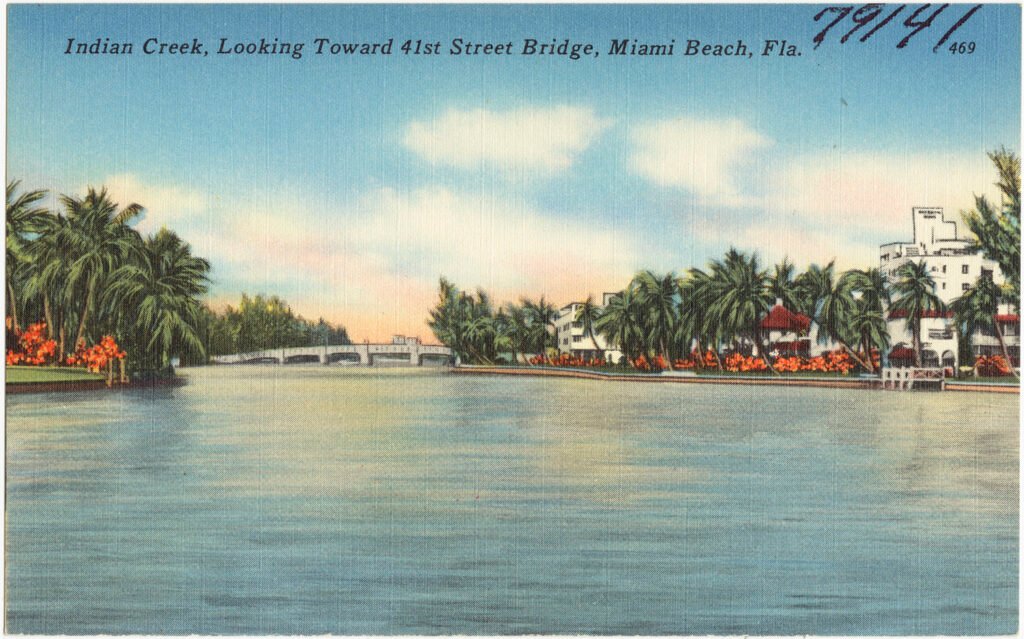
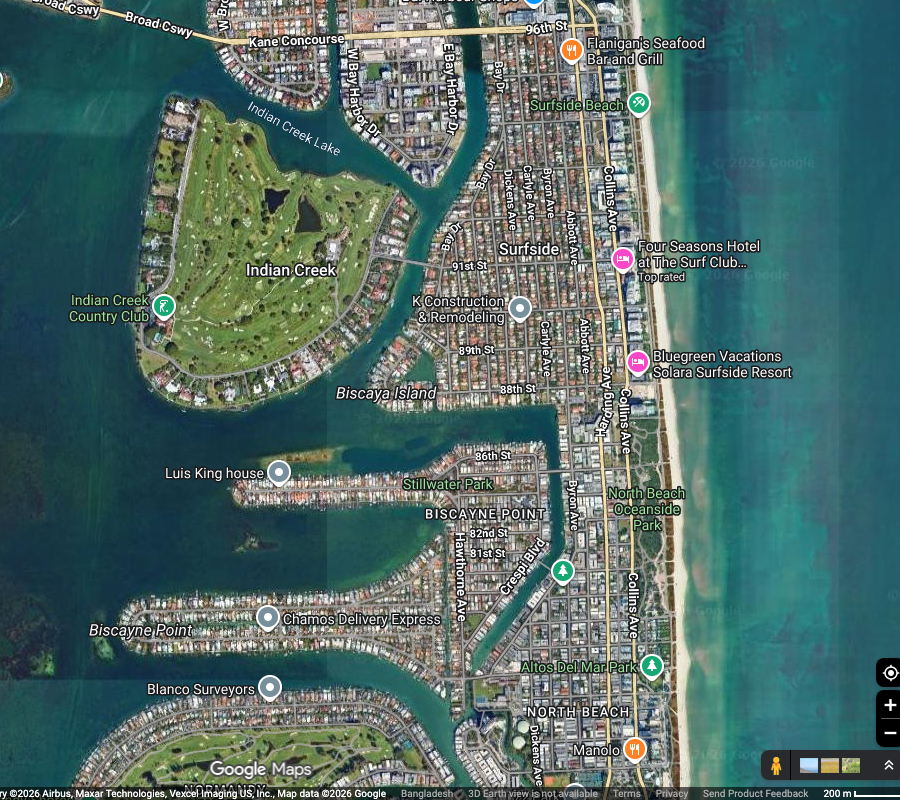
Which Indian Creek? This review covers Indian Creek Country Club in Indian Creek Village, Florida — the invitation-only club on the private island north of Miami Beach known as the “Billionaire Bunker.” It is not the public Indian Creek Golf Club in Carrollton, Texas, and not the clubs of the same name in Marion, Iowa or Omaha, Nebraska. At least four American clubs share this name, which is why so many searches land on the wrong one.
I have spent more than twenty years around private clubs — as a member, and on a membership committee that had to tell people no. That experience is why this review is written the way it is.
Because here is the thing I have to say up front: I have not played Indian Creek, and neither has any reviewer you will find online. The island has one bridge, its own police force, and 24/7 armed boat patrols. There are no public tee times, no outside events, and no reciprocal walk-ons. Anyone publishing a “what it’s like inside” account is either a member breaking club etiquette or making it up.
So this is a different kind of review, and I think a more useful one. It is built from documents rather than a round of golf: the club’s IRS Form 990 filings, national reporting on its membership, architectural records of the course, and the public record of who has and has not been let in. Most of what follows is not published anywhere else, and some of the numbers you will find elsewhere are demonstrably wrong. For how we score, see our review methodology, and our other country club reviews for clubs you can actually join.
Indian Creek Country Club: Fast Facts
| Detail | Info |
|---|---|
| Club Type | Private country club — invitation only |
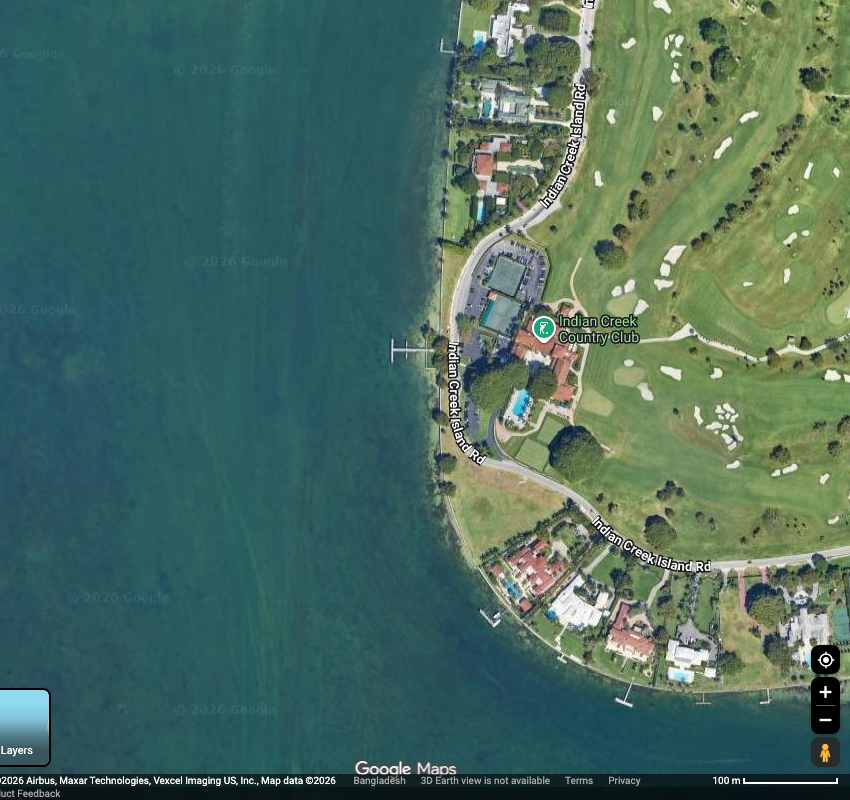
| Location | 55 Indian Creek Island Rd, Indian Creek Village, FL 33154 |
| Course opened | 1930 (island land assembled 1928; village incorporated 1939) |
| Membership size | ~350 members |
| Membership categories | Not disclosed publicly |
| Initiation Fee | Reported close to $1,000,000 (WSJ, Aug 2026) |
| Annual Dues | Reported ~$44,000 (WSJ, Aug 2026) |
| Waitlist | No published list — admission is by invitation, not queue |
| Sponsorship Required | 2 member sponsors + letters from 5 additional members |
| Golf | 18 holes, par 72, ~6,600–6,800 yards, William S. Flynn (1930), restored by Andrew Green (2022) |
| Other Amenities | Italianate clubhouse, tennis, pool, fitness, marina, dining |
| Course ranking | 16th in Florida — Top100GolfCourses |
| Tax status | 501(c)(7) social club, EIN 59-0302870 |
| Official Website | indiancreekcountryclub.org (members-only login) |
| Phone | (305) 866-5751 |
Membership Costs and Fees
Indian Creek publishes nothing. No rate card, no membership page, no inquiry form. The most credible figures come from Wall Street Journal reporting in August 2026, relayed by Fortune: an initiation fee close to $1 million and annual dues of about $44,000, across roughly 350 members.
Why the numbers you will find elsewhere are wrong
Several club-directory sites publish a “rumoured” $300,000 initiation and estimated dues of $20,000 per month. That second figure is arithmetically impossible, and the club’s own tax return proves it.
$20,000 a month is $240,000 a year. Across roughly 350 members that would be about $84 million in dues income. Indian Creek’s Form 990 for fiscal 2024 reports total revenue of $13,342,010. The published estimate is off by a factor of six.
What the tax filings actually show
This is the part no other review of this club uses. As a 501(c)(7) social club, Indian Creek files a public Form 990 under EIN 59-0302870.
| Fiscal year | Revenue | Expenses | Net | Net assets |
|---|---|---|---|---|
| 2024 | $13,342,010 | $17,669,038 | −$4,327,028 | $26,299,220 |
| 2023 | $10,887,535 | $15,464,999 | −$4,577,464 | $25,022,648 |
| 2022 | $6,933,196 | $11,784,009 | −$4,850,813 | $20,197,462 |
| 2017 | $9,376,627 | $9,737,491 | −$360,864 | $11,330,024 |
Two things jump out. First, the club has reported a loss every single year since 2017, and the losses got much bigger from 2022 onward — roughly $13.8 million of deficit across 2022, 2023 and 2024 alone.
Second, and more revealing: net assets nearly doubled over that same stretch, from $11.3 million in 2017 to $26.3 million in 2024. A club cannot lose money for eight straight years and still grow its balance sheet on operations. That gap is the signature of initiation income being booked to capital rather than to revenue — which is exactly how a seven-figure joining fee works. The operating deficit is not distress. It is the design.
Revenue per member: a useful cross-check
Divide 2024 revenue by roughly 350 members and you get about $38,100 of club revenue per member per year. Set that against the reported $44,000 dues figure and the picture is coherent: dues are effectively the entire revenue line, with very little coming from outside events, outings or public play — because there aren’t any.
The 2022 renovation also shows up in the numbers. Revenue jumped from $6.9 million in 2022 to $13.3 million in 2024 while expenses climbed from $11.8 million to $17.7 million, consistent with a club that closed its course, restored it, and reopened at a higher cost base.
The fee lines nobody publishes
Honest answer: guest fees, cart and trail fees, locker and bag storage, and food-and-beverage minimums are not public for this club, and I am not going to invent them. One directory reports that members are expected to contribute to the club’s charitable foundation, without naming an amount — treat that as unverified. What the 990 does confirm is the staffing cost of the experience: the general manager was compensated $390,449 in 2024 and the chief financial officer $272,241.
For how ownership shapes what members can see, read equity vs non-equity clubs.
How to Join Indian Creek Country Club
You don’t. That is not a joke — there is no application form, no inquiry line, and no membership office to call. Admission begins with existing members deciding they want you.
The reported process, per the same August 2026 reporting:
- Two current members sponsor you. Not acquaintances — sponsors put their own standing behind the nomination.
- Five additional members write letters of recommendation. That is seven members who must actively want you in.
- A six-person membership committee reviews the nomination.
- A fifteen-member board votes.
Notice what is missing: money is nowhere in that list. It is a prerequisite, not a qualification.
Owning a house on the island does not get you in
This is the single most misunderstood fact about Indian Creek, and the reason it has been in the news. Property ownership and club membership are entirely separate.
Jeff Bezos has bought three properties on the island for a combined $234 million — $68 million in 2023, roughly $79 million next door, and $87 million in 2024 — and is reportedly still not a member. He attended the club’s dock party in February 2026 as a guest. Mark Zuckerberg, who paid $170 million for an estate there, is likewise reported to be outside the membership. Jared Kushner and Ivanka Trump have reportedly spent years attending events and playing golf with members without being admitted.
Members who have been admitted reportedly include Goldman Sachs CEO David Solomon, Tom Brady, Jersey Mike’s chairman Peter Cancro and financier Carl Icahn. Historically the roll skewed toward South Florida’s established professional class — doctors, attorneys, developers and financiers — rather than national celebrity.
If you take one thing from this section: at Indian Creek, a loud public profile appears to be a liability rather than an asset.
Amenities: The Full Tour
Golf
The course is the reason the club has an architectural reputation rather than just a tabloid one. William S. Flynn laid it out in 1930 — the same architect responsible for Shinnecock Hills and Cherry Hills — on filled land in Biscayne Bay, with the holes ringing the island and the estate lots facing them.
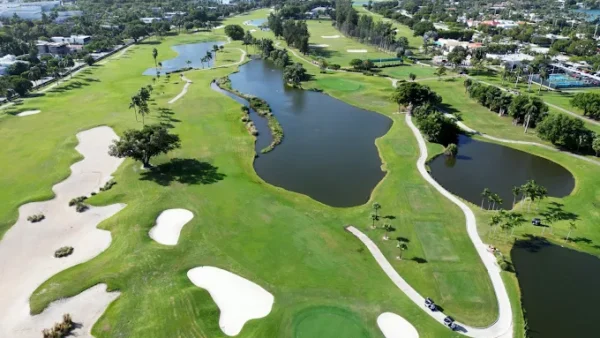
In 2022 Andrew Green completed a full restoration. The work expanded the greens back toward their original footprints, relocated and reshaped bunkers, added tees, rebuilt drainage, and added two large ponds for water storage. The playing surfaces were regrassed — TifTuf Bermuda fairways, TifEagle greens, Primo Zoysia tees.
It plays to a par of 72 at roughly 6,600 yards from the original tees, which tells you this is a course defended by wind, angles and green complexes rather than length. The par-4 9th stretches to 470 yards; the drivable-adjacent 13th plays 309. Top100GolfCourses ranks it 16th in Florida and reviewers there describe conditioning that stands comparison with anywhere in America.
For contrast on the same barrier island chain, the municipal Miami Beach Golf Club is a genuinely good public alternative about fifteen minutes south — and you can book it today.
Racquet Sports, Pool and Fitness
Indian Creek is documented as having tennis, a pool and fitness facilities, but the club publishes no court count, surfaces, class schedule or service list. On pickleball, which I check for every club because it is the fastest-growing amenity in American club life, there is no reliable public evidence either way. Absence of evidence is not evidence that it is absent.
Clubhouse and Events
The documented centerpiece is an Italianate clubhouse with terraces and loggias facing the course and Biscayne Bay. Marina access and boat arrival fit the island setting. Public sources do not establish ballroom capacity, meeting-room inventory or a current outside-event policy, so those details should be confirmed through a sponsoring member rather than a directory.
Directory sites list twelve tidy amenity categories for this club. Those lists are generic templates, not reporting. One of them also describes “two 18-hole courses” — Indian Creek has one.
Dining & Social Calendar
Dining exists, but named venues, menus, minimums and the regular member calendar are not public. The February dock party reported in 2026 confirms that private social events use the bayfront setting; it does not establish a schedule available to prospective members. I will not turn a members-only operation into a fictional restaurant guide.
Family & Kids
No credible public source documents junior golf, tennis or swim programmes, summer camps, childcare, teen access or fitness age limits at Indian Creek. That means family programming is unknown, not nonexistent. A family evaluating those services would need answers from its sponsors before treating the reported initiation fee as an all-family lifestyle purchase.
Guest Policies and Access
Guest access is member-accompanied and tightly controlled. Reaching the island at all requires an invitation from a resident or a member; the village maintains its own police force and patrols the surrounding water. There is no published reciprocal programme, no outing calendar, and no charity-event route in — the usual side doors into private clubs are closed here.
Culture, Dress Code and Vibe
Every private club has a stated culture and a real one. At Indian Creek they appear to be the same thing: discretion.
The membership has reportedly resisted admitting wealthy newcomers whose presence would change the character of the island — the concern being noise, attention and paparazzi rather than money. In a club of roughly 350 on an island of 41 homes, one member who attracts helicopters affects everybody.
The dress code is not published. Based on the club’s era, architecture and peer group, expect traditional club standards — collared shirts, no denim on the course, jackets for certain dining rooms — but I have no document to cite and I am not going to state it as fact.
What Members Actually Say
Direct member chatter is almost nonexistent, and that is itself the finding. Searches across Reddit, city-data, GolfWRX and general review platforms produce almost no verified members discussing dues, assessments, dining or family life.
The consistent praise: first-hand visitors in a 2024 Golf Club Atlas discussion repeatedly described firm, fast conditions, opened sightlines and a classic Florida clubhouse. One guest said his member host, who served on club committees, reported that members were serious about restoring the Flynn character and happy with the result. That is credible member-adjacent evidence, not a broad sentiment sample.
The consistent complaint: there is no verifiable member complaint to synthesize. Even access rules are opaque: a 2026 wedding-planning thread contains conflicting reports about whether nonmembers can hold events. That contradiction demonstrates the information gap; it does not prove the current policy.
The surprise: the architecture community rates this club far higher than the celebrity coverage would suggest. Among people who have actually seen the course, the 2022 Flynn restoration is the story — not the Bezos saga. For a club this famous, member silence remains the most honest culture signal available.
What I Liked and What I Didn’t
What stands out.
- A William S. Flynn original, sensitively restored by one of the best architects working today.
- Conditioning that specialists rank among the best in the country.
- A genuinely private island setting that no amount of money can replicate elsewhere in Miami.
- A membership process that selects for character over net worth — rarer than clubs claim.
- Financial substance: $26.3 million in net assets, nearly doubled since 2017.
What gives me pause.
- There is no path in for essentially any reader of this review.
- Zero fee transparency — every number here is reported or derived, not published.
- Eight consecutive years of operating deficits, which puts long-term pressure on dues and assessments.
- A social vetting process that is, by design, exclusionary and unaccountable.
- No public information on family programmes, dining or racquet facilities.
Is It Worth It? The Cost-Per-Round Math
Take the reported figures at face value: $1,000,000 initiation, $44,000 annual dues.
Amortise the initiation over twenty years of membership and it adds $50,000 a year. All-in, that is roughly $94,000 per year before a single meal or guest fee.
| Rounds played per year | Dues only | Dues + amortised initiation |
|---|---|---|
| 20 rounds | $2,200 per round | $4,700 per round |
| 40 rounds | $1,100 per round | $2,350 per round |
| 60 rounds | $733 per round | $1,567 per round |
No golfer joins Indian Creek for the golf economics. At 60 rounds a year you are paying more per round than a green fee at almost any resort course in America.
What you are actually buying is the island, the neighbours, and the fact that the answer is usually no. Judged as a golf purchase it is indefensible. Judged as the social centre of a 41-home private island, the price is doing exactly what it is supposed to do.
For comparison, Riviera Country Club offers a comparable tier of architecture and prestige with a membership that is at least theoretically approachable.
Who Is Indian Creek Country Club For?
This club is a good fit if you are already inside the circle — an established South Florida family, or a national figure whose sponsors can vouch that you will protect the club’s privacy.
This club is a good fit if you value a restored Flynn course, a tiny member population and discretion more than transparent pricing or a publicly documented amenity programme.
Skip this one if you are assembling a shortlist of Miami clubs you can approach. Indian Creek has no normal application path, and money or island property does not create one.
Skip this one if you need published family programming, reciprocal access or predictable all-in costs before making a decision. This review can document the gaps, but only member sponsors can resolve them.
People Also Ask: Frequently Asked Questions
How much does it cost to join Indian Creek Country Club?
The club does not publish fees. Wall Street Journal reporting in August 2026 put the initiation fee at close to $1 million with annual dues of about $44,000. Older directory estimates of $300,000 initiation and $20,000 monthly dues are not supported by the club’s own tax filings.
Can you buy your way into Indian Creek Country Club?
No. Admission requires two member sponsors, recommendation letters from five additional members, review by a six-person membership committee and a vote of a fifteen-member board. Money is a prerequisite, not a qualification. Several billionaires with property on the island have reportedly not been admitted.
Is Jeff Bezos a member of Indian Creek Country Club?
Reportedly not. Bezos has bought three Indian Creek properties for a combined $234 million and attended the club’s February 2026 dock party as a guest, but as of August 2026 he is reported to remain outside the membership. Owning a home on the island confers no membership rights.
Do you have to live on Indian Creek Island to join the club?
No, and living there does not get you in either. Residency and membership are entirely separate at Indian Creek. Non-residents have been admitted while owners of multimillion-dollar island estates have not, which is unusual among American club communities. The club and village operate independently, so a deed creates no priority.
Can you play Indian Creek Country Club as a guest?
Only if a member invites and accompanies you. There are no public tee times, no outside outings and no published reciprocal access. Reaching the island itself requires an invitation, as it has a single bridge, its own police force and round-the-clock water patrols.
Who designed the Indian Creek golf course?
William S. Flynn designed the course, which opened in 1930. Flynn also designed Shinnecock Hills and Cherry Hills. Architect Andrew Green completed a full restoration in 2022, expanding greens, reshaping bunkers, rebuilding drainage and regrassing the course with TifTuf, TifEagle and Zoysia surfaces.
Verdict
GCR Score: 4.6 / 5. This score reflects the club itself — a superb Flynn course freshly restored, a setting nothing in Miami can match, and real financial substance behind it. It is not a score for attainability, and the two should not be confused.
Indian Creek is the rare club where the honest consumer verdict is simply: this is not a decision you get to make. There is no application to submit and no waitlist to join. If seven members ever decide to put you forward, you will not need this review to tell you whether to say yes.
What I can tell you is that the club is exactly what it appears to be. The tax filings show an institution spending well beyond its operating income to maintain a standard, funded by joining fees large enough to cover the gap. The course rankings show the money is going into the ground. The membership record shows the vetting is real rather than performative.
Last reviewed: 27 August 2026. Fees are reported figures, not club-published rates, and can change.
Author Note
I assess clubs through cost, access, and the details prospective members usually discover too late. For Indian Creek that meant reading tax returns instead of a scorecard — and being clear about the line between what is documented and what is guessed.